Early Childhood Educator CDA Credentialing Pathway Initiative
Strengthen the Fairfax County Early Childhood Educator Workforce Pipeline through the Child Development Associate (CDA) Credential Mentoring Program
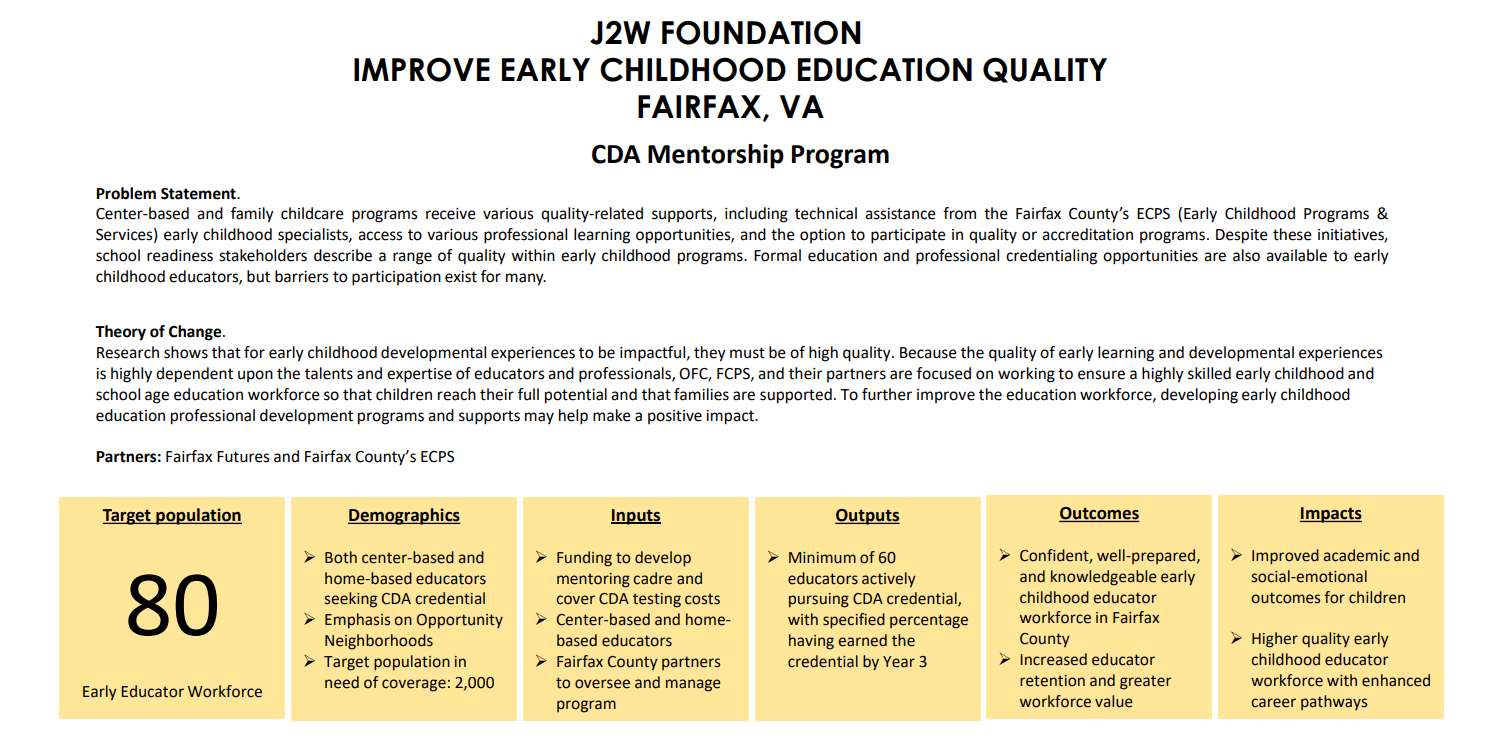
- Develop a multi-year program designed to improve the quality of early childhood education in Fairfax County, VA set to begin in 2021, running through 2025
- Partnering with Fairfax Futures and ECPS (Early Childhood Programs & Services)
- Program will support the professional learning and development of the early childhood educator workforce and thus further improve the success of children in kindergarten and beyond
- Identify CDA candidates and then help guide these cohorts to successfully attain the credential
- Program is directly linked to the Fairfax County Equitable School Readiness Strategic Plan and to the J2W Foundation Strategic Plan IMPACT.2023 and IMPACT.2027
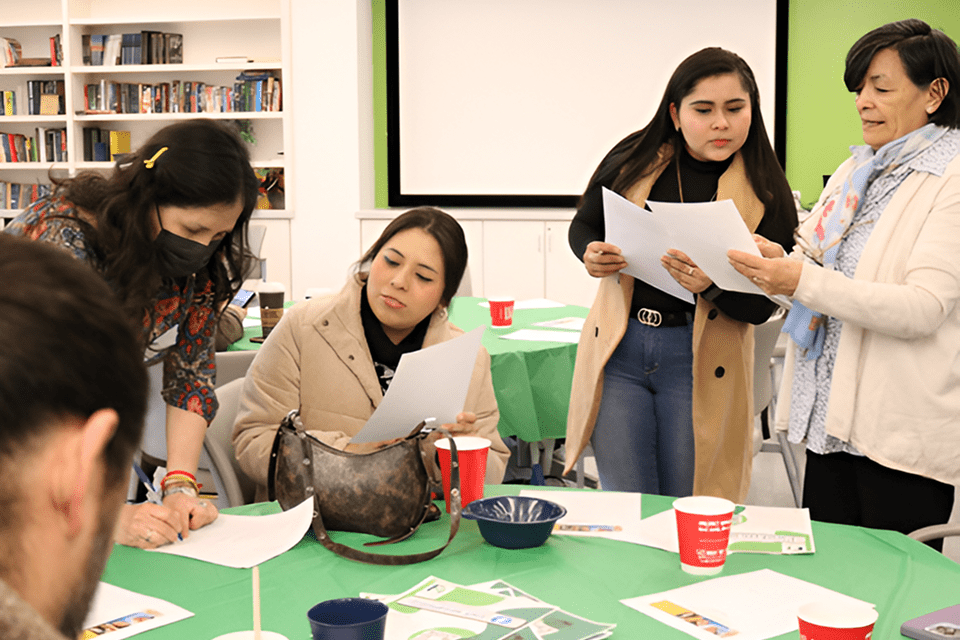
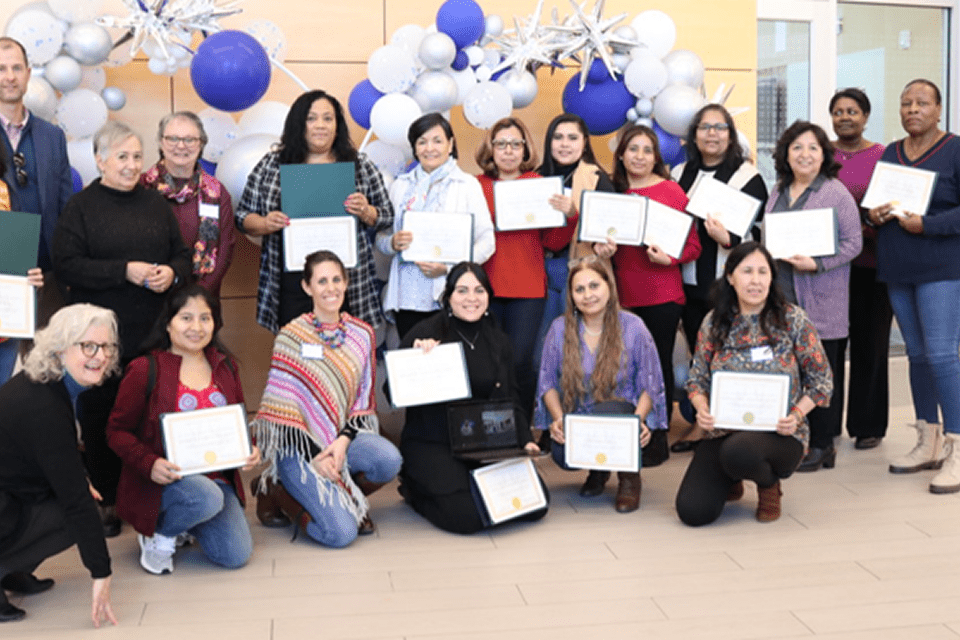
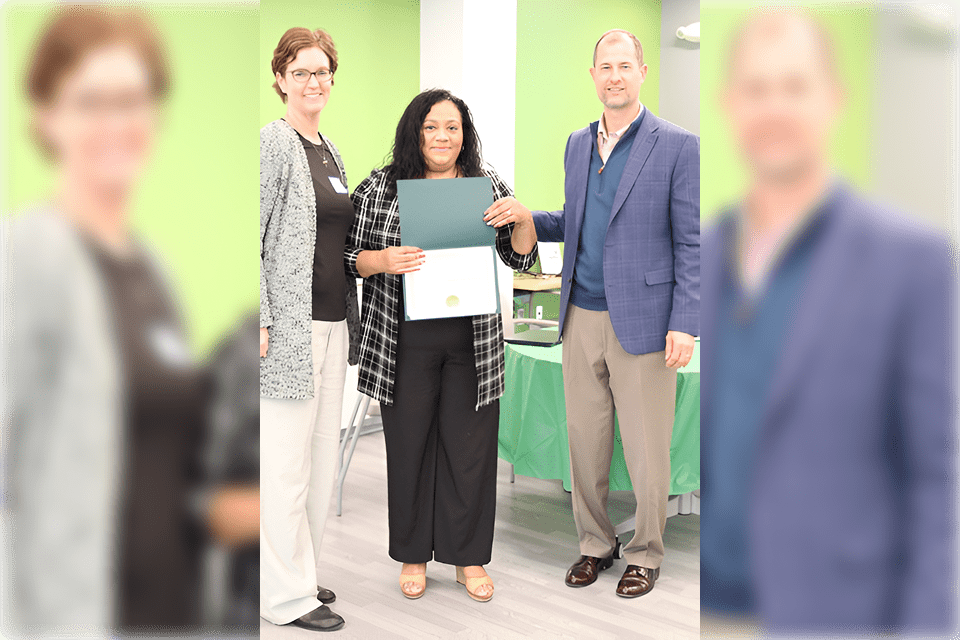
“I am very excited and happy to start my CDA. This is life-changing for me. I feel so blessed that I am surrounded by wonderful people who are working on doing great things and supporting early childhood educators so we can provide the best care to our young children and future leaders. Thank you, Thank you, Thank you!!” – Aspiring CDA educator, June 2021
Measures of Performance
For more information, please see Data Analysis section at the bottom of the page
End of Program
Data Analysis
-
- Goal: To pilot a new early childhood educator program to support the professional learning and development of the ECE workforce, with the intent to further improve the success of children in kindergarten and beyond. The mentoring program will look to identify CDA candidates and then help guide these cohorts with a professional consulting team to successfully attain the credential.
- The CDA Mentoring Program was run by the Fairfax County-based Fairfax Futures non-profit organization, in partnership with Fairfax County’s Early Childhood Programs and Services (ECPS).
- By the end of program (Q2/2025), we had measured several output measures:
- The program-end target was to maintain a cohort between approximately 35-45 educators, with a mix of both home-based and center-based participants. At program end, there were 38 educators actively seeking their CDA (23 from home-based programs and 15 from center-based programs); 61% of these were from Opportunity Neighborhoods; and 84% were English Language Learners. We deemed the participation levels and demographics to be successful, or “green.”
- By July 2025, the program successfully graduated 33 educators (22 from home-based programs and 11 from centers). Of these 33, 19 (58%) worked within Opportunity Neighborhoods and 29 (88%) were English Language Learners. We expect another 5 educators to graduate by the end of 2025, even though J2W will no longer be tracking metrics at that point.
- While we were currently, at program end, seeing a decrease in both numbers of educators starting their CDA portfolios and the numbers of educators completing their portfolios, much of that was a result of timing whereby many educators recently graduated the multi-year CDA pathway process and/or were close to graduation but not yet finished with their portfolio development.
- We developed and launched two annual outcome metric surveys at the end of 2022 to our CDA population with Fairfax County to assess how the educators feel the CDA helped both their own professional development as well as how the credential impacted student performance.
- Baseline data on how educators perceive the CDA helped, or greatly helped, develop their career goals scored 95%. We did see a drop in perception when the survey was administered again in Q4/24 (moved from 95% to 77%). Our final survey ended in Q2/25 with 79%. Our goal was a minimum of 80%, thus we closed out this metric as “yellow.”
- Baseline data on how educators perceive the CDA positively impacted, or greatly impacted, the lives of the children taught scored 94%. Similarly, we saw a drop in the Q4/24 survey from 94% to 75%, and ended the program at 81%, earning a “green” health score as our goal was a minimum of 80%.
- Ultimately, we believe this strategy to be very successful over these past 4 years. Beyond the graduation rates and participation, we’ve noted the following:
- The program will continue and be sustainable moving forward without the need for future J2W funding, thus impacting early childhood educators for years to come. The work of the consulting team will be allocated across several ECPS offices within Fairfax County to manage the coursework, training modules/curriculum, and expenses. Fairfax Futures also began training volunteer peer mentors to assist educators in navigating the CDA pathway. At the time of reporting, there were currently 8 peer mentors supporting the work, each with multiple applicants.
- In the spring of 2023, Fairfax Futures was recognized for its work as a finalist in the Saul Zaentz Early Education Initiative at the Harvard Graduate School of Education. Fairfax Futures participated in their Innovation Challenge pitch competition in Boston, MA.
- Fairfax Futures also presented its work at the 2023 National Association for Family Child Care Annual Conference in Atlanta, GA and the 2023 Council for Professional Recognition Annual Conference in Houston, TX.