Program Summary
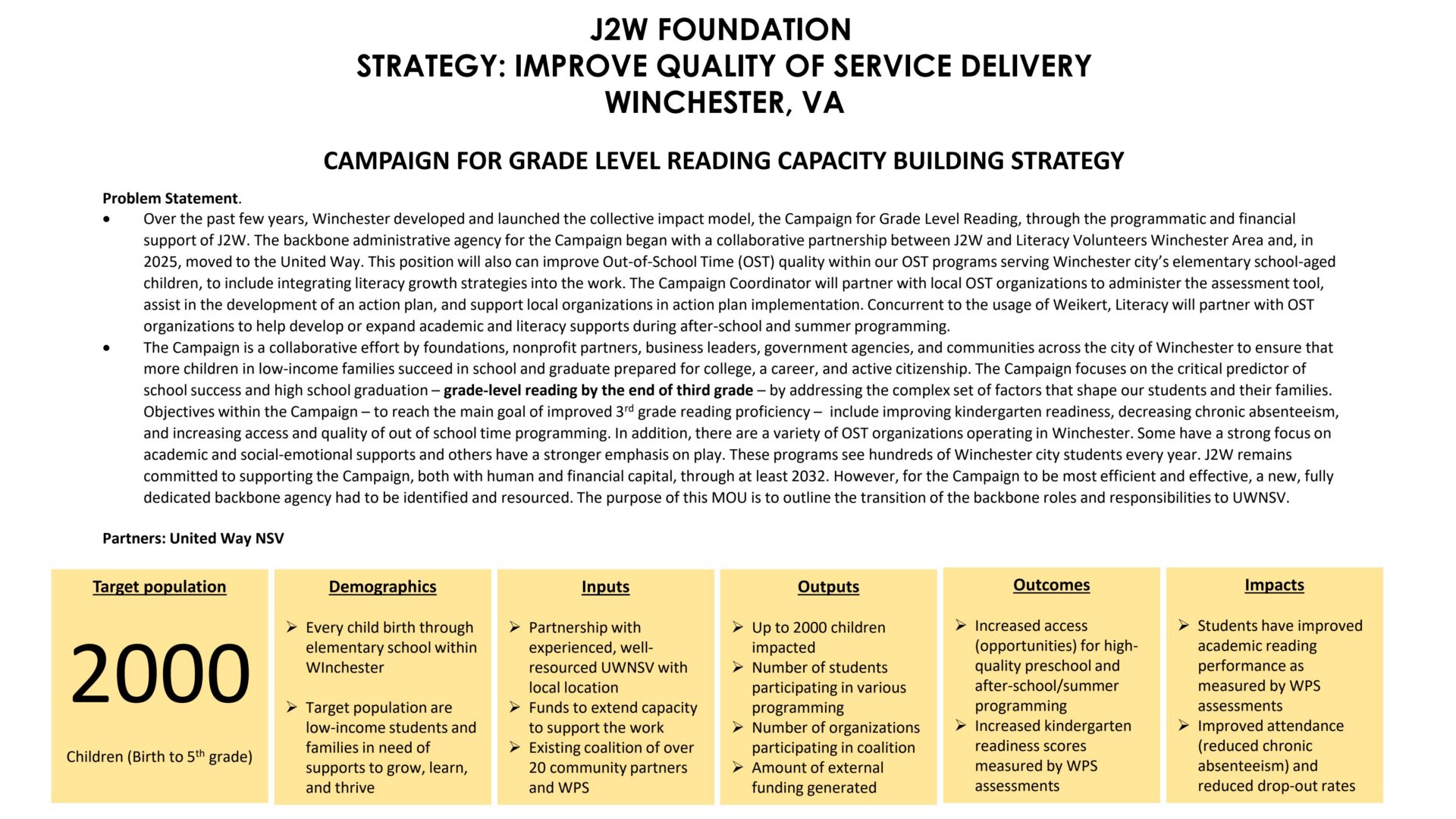
1. Goal: J2W will provide sufficient funding to cover a full-time position fully dedicated to managing the Winchester Campaign for Grade Level Reading backbone role. The overarching objective of this investment will be to allow the United Way Northern Shenandoah Valley to take ownership of the backbone management of the Winchester Campaign and to do this resourced appropriately to not only sustain the Campaign over its 10-year lifetime, but to grow its influence and impact.
2. Framework: The United Way NSV will manage the backbone organization for Winchester’s Campaign for Grade Level Reading strategy. Leveraging the existing resources of the United Way and its site in Winchester, VA, this Campaign program position will provide the capacity necessary to take over the backbone role and further the programming, reach, messaging, and impact of the
Campaign within the county. The backbone activities will include:
- Convening, Partnership Development, and Fundraising
Bring together all resources including groups and individuals related to learning in the city, in order to build action plans and deliverables to meet and exceed goals. Build the network of community leaders, organizations, and stakeholders that have agreed to be part of the support and growth of learning initiatives across the community. Develop and create the partnerships and meeting mechanisms that best advance our goals, including developing a fundraising plan to bring in additional resources in the form of grants and public/private contributions to ensure sustainable success
- Communications & Storytelling
Advance all the good work being done by caring organizations across the county and through the Campaign, through multiple media platforms to elevate the messaging and availability of options for learning across the community. Build the brand and messaging that our community turns to for partnership to solve challenging problems, as well as tell the stories of success for improving the learning opportunities available to the entire community
- Alignment & Coordination
Consistent with our vision to bring together the best of what is available to our community to facilitate learning, connect to all the appropriate partners and entities focused on improving learning and skill development across the community. Coordinate all organizations devoted to some aspect of learning in county that advances our goals
- Data Analysis, Research, and Reporting
Maintain and communicate a reporting dashboard with success metrics that are determined and aligned on with all stakeholders in advance of any work projects to be engaged. Success metrics will be researched against appropriate industry benchmarks, analysis will be used to identify trends that can be utilized for project refinements, and reporting consistent with preset expectations for all stakeholders and reporting requirements and agreements.
- Professional Development & Capacity Building
Assess, develop, and build upon the capacity of all partner organizations to deliver against the action plans put in place to effect change and deliver results needed to meet our goals. We will determine how to be most helpful to the community, school district, and all stakeholders. Our intention is to continue to look for grants, resources, and best practices to bring to all so that they can grow their teams and their capacities to maximize their programs to meet the needs of the community
3. J2W will provide 3-years of funding to the cost of the program.
Measures of Performance
For more information, please see Data Analysis section at the bottom of the page
Data Analysis
- Goal: J2W will provide sufficient funding to cover a full-time position fully dedicated to managing the Winchester Campaign for Grade Level Reading backbone role. The overarching objective of this investment will be to allow the United Way to take ownership of the backbone management of the Winchester Campaign and to do this resourced appropriately to not only sustain the Campaign over its 10-year lifetime, but to grow its influence and impact. The second goal of this grant is to improve Out-of-School Time (OST) quality within our OST programs serving Winchester city’s elementary school-aged children, to include integrating literacy growth strategies into the work.
- Theory of Change: With a fully dedicated and well-resourced Campaign for Grade Level Reading administrative agency, the Campaign will have a greater impact in the community. The backbone agency will be better able to maximize community engagement; improve strategic communications and positive messaging on the importance of literacy, attendance, and reduction in learning loss; and to improve Out-of-School Time (OST) quality within our OST programs serving Winchester city’s elementary school-aged children, to include integrating literacy growth strategies into the work.
- OST Quality Strategy Framework: Designed to first train United Way staff on the Weikart quality assessment model. Then, UWNSV staff will partner with local OST organizations to administer the assessment tool, assist in the development of an action plan, and support local organizations in action plan implementation.
- OST Theory of Change: There are a variety of OST organizations operating in Winchester. Some have a strong focus on academic and social-emotional supports and others have a stronger emphasis on play. These programs see hundreds of Winchester city students every year. OST programs have the opportunity to be not only safe and fun spaces, but places that can further help our children with additional academic and social-emotional enrichment supports. What binds all of these agencies together is the desire to improve students’ confidence and agency of self while building stronger, more resilient children.
- Performance Measures:
- OST Alignment and Quality Systems Building: This OST portion of the job description has not started. With the new hire of the Campaign Manager position, we will look to begin training in the fall of 2026 and implementation in early 2027.
- Campaign Management: This portion of the strategy has a focus on creating a strong foundation and set of processes by which the Campaign can and should perform most effectively. We assess the grant effectiveness by analyzing the following factors regarding our ability to:
- Expand community capacity
- Amplify the message
- Align on targets and outcomes
- Coordinate strategy across Winchester
- Results:
- OST Outputs and Outcomes:
- Participation in Weikart Quality Assessment: Training will begin in the fall of 2026.
- Weikart Assessments: OST program assessments will begin in the spring of 2027.
- Campaign Capacity Outputs:
- Meeting Management: Our intent is to host regularly scheduled, well-attended committee meetings for each of the four key working groups (Steering, School Readiness, Out-of-School Time, and Attendance), 100% of the time; and to host two strategic retreats per year, facilitated by the Smarter Learning Group consultants to benchmark our Campaign against like-Campaigns across the country. By the end of Q2/26, the Campaign backbone organization ran all Committee meetings (100% achieved), earning a “green” health score and has so far hosted one SLG strategic retreat for 2026 (50% achieved), earning a “green” score, knowing the second retreat will occur in Q4/26.
- Strategic Messaging: Our intent is to develop and broadly distribute a quarterly newsletter outlining the activities and progress of the Dorchester Campaign. Thus, our goal is to deliver 4 newsletters per year. By Q2/26, the Campaign has not distributed its newsletters, earning a “red” health score, making its resumption a key priority for the latter half of 2026. In addition, the Campaign has a goal of hosting one, annual State of the Campaign public event that is intended to provide an in-person opportunity for the community to learn more about the Campaign’s activities and outcomes. To date, the presentation has not occurred but is expected in Q3 or Q4/26, thus also currently earning a “red” score.
- Successes to date include a full committee review/approval of the Community Solutions Action Plan (CSAP, or strategic plan), the governing charter, and a revision of the Partner and Friends agreements. By the end of 2026, each working committee is expected to have an approved Statement of Purpose, set of priority work objectives, and a longitudinal data scorecard for measuring outputs and outcomes.
- OST Outputs and Outcomes: